
Your AI should get cheaper every time you use it.
Capture your AI work traces, automatically codify them into skills, serve them using in-house models, saving 80%+ on costs
Optimize your work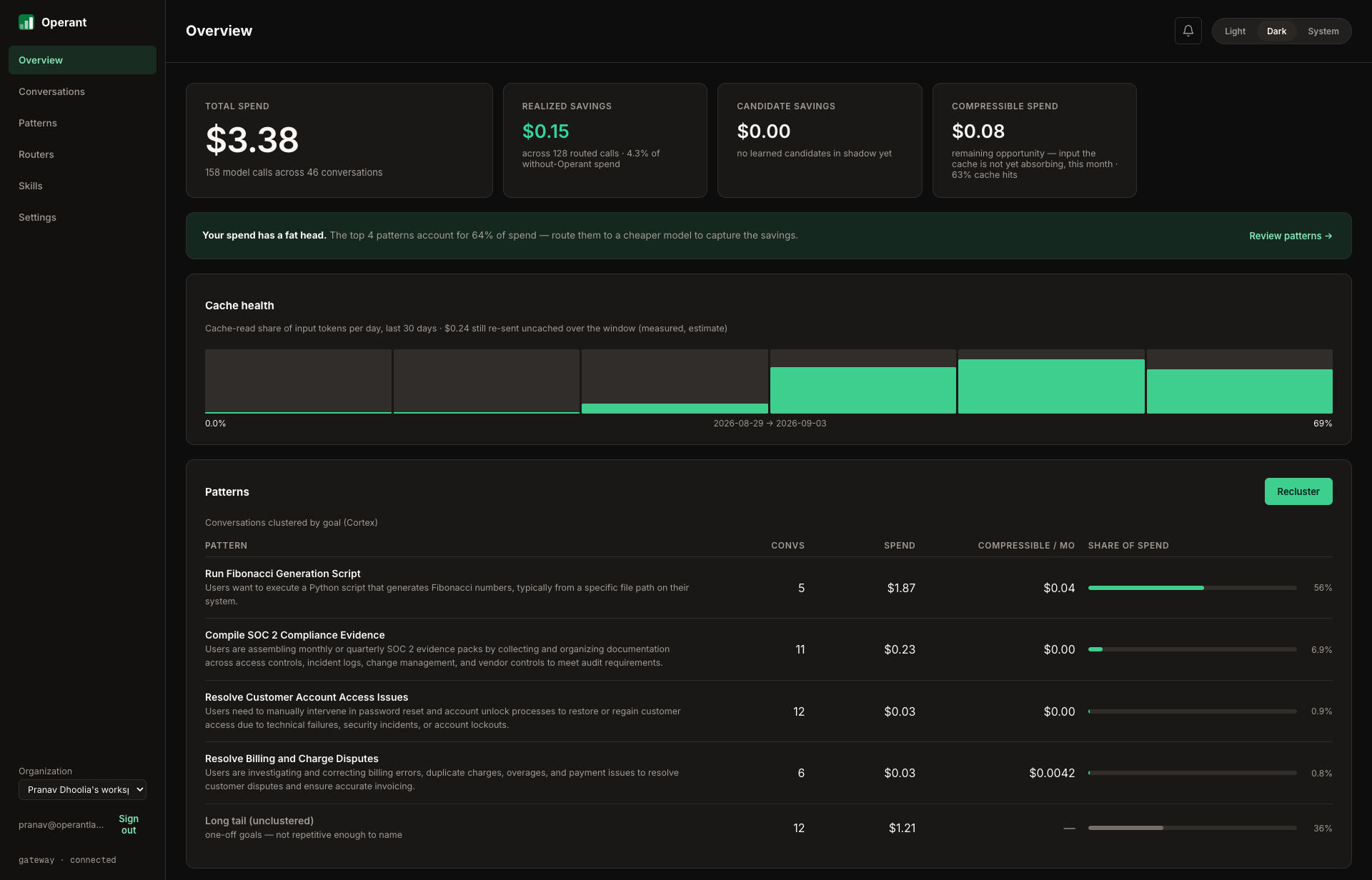
The right model for each task. A fraction of the cost.
As Operant codifies your recurring work into skills and serves them with in-house models, the same tasks cost less every month — projected here, verified per call.
How the ledger works ->Illustrative projection of the same workload's bill as recurring tasks are codified into skills and served by in-house models. Savings are verified per call on the ledger, never assumed.
Point Operant at your AI agent.
Point Operant at your agent
Two lines in your agent's environment. No code change. Your agent keeps working exactly as before — through Operant.
It learns the work
It watches how the agent works and writes a skill, so a cheaper model can do the same job.
A new model must earn the job
Operant keeps testing them. A new model only takes over when it is better, cheaper, faster, or safer.
You own the models.
A few things people ask first.
No. Operant speaks the Anthropic and OpenAI wires. You set two values: the base URL and your Operant key. You keep your prompts, tools, and SDKs. Address a router as the model, and the gateway chooses for each turn.
Yours. Store a provider key, encrypted at rest. Mint an Operant key for each agent. The gateway strips the Operant key, injects yours at forward time, and stamps every call with the key that sent it.
You decide. Observe-only is the default and changes nothing on the wire. Capture is tiered. The trace shows both what the app said and what Operant sent to the provider. You can undo it in a minute: set the base URL and your provider key back.
Nothing changes without proof. Operant replays held-out work through the candidate and scores it against the frontier model’s own answers. It takes live traffic only when its average score clears the bar, 0.8 by default, and you ratify. One click demotes it, and demote is never gated.
No. Operant speaks the Anthropic and OpenAI wires. You set two values: the base URL and your Operant key. You keep your prompts, tools, and SDKs. Address a router as the model, and the gateway chooses for each turn.
Yours. Store a provider key, encrypted at rest. Mint an Operant key for each agent. The gateway strips the Operant key, injects yours at forward time, and stamps every call with the key that sent it.
You decide. Observe-only is the default and changes nothing on the wire. Capture is tiered. The trace shows both what the app said and what Operant sent to the provider. You can undo it in a minute: set the base URL and your provider key back.
Nothing changes without proof. Operant replays held-out work through the candidate and scores it against the frontier model’s own answers. It takes live traffic only when its average score clears the bar, 0.8 by default, and you ratify. One click demotes it, and demote is never gated.
No. Operant speaks the Anthropic and OpenAI wires. You set two values: the base URL and your Operant key. You keep your prompts, tools, and SDKs. Address a router as the model, and the gateway chooses for each turn.
Yours. Store a provider key, encrypted at rest. Mint an Operant key for each agent. The gateway strips the Operant key, injects yours at forward time, and stamps every call with the key that sent it.
You decide. Observe-only is the default and changes nothing on the wire. Capture is tiered. The trace shows both what the app said and what Operant sent to the provider. You can undo it in a minute: set the base URL and your provider key back.
Nothing changes without proof. Operant replays held-out work through the candidate and scores it against the frontier model’s own answers. It takes live traffic only when its average score clears the bar, 0.8 by default, and you ratify. One click demotes it, and demote is never gated.
No. Operant speaks the Anthropic and OpenAI wires. You set two values: the base URL and your Operant key. You keep your prompts, tools, and SDKs. Address a router as the model, and the gateway chooses for each turn.
Yours. Store a provider key, encrypted at rest. Mint an Operant key for each agent. The gateway strips the Operant key, injects yours at forward time, and stamps every call with the key that sent it.
You decide. Observe-only is the default and changes nothing on the wire. Capture is tiered. The trace shows both what the app said and what Operant sent to the provider. You can undo it in a minute: set the base URL and your provider key back.
Nothing changes without proof. Operant replays held-out work through the candidate and scores it against the frontier model’s own answers. It takes live traffic only when its average score clears the bar, 0.8 by default, and you ratify. One click demotes it, and demote is never gated.
No. Operant speaks the Anthropic and OpenAI wires. You set two values: the base URL and your Operant key. You keep your prompts, tools, and SDKs. Address a router as the model, and the gateway chooses for each turn.
Yours. Store a provider key, encrypted at rest. Mint an Operant key for each agent. The gateway strips the Operant key, injects yours at forward time, and stamps every call with the key that sent it.
You decide. Observe-only is the default and changes nothing on the wire. Capture is tiered. The trace shows both what the app said and what Operant sent to the provider. You can undo it in a minute: set the base URL and your provider key back.
Nothing changes without proof. Operant replays held-out work through the candidate and scores it against the frontier model’s own answers. It takes live traffic only when its average score clears the bar, 0.8 by default, and you ratify. One click demotes it, and demote is never gated.